The first dental appointment is a bigger deal for parents than it is for kids. You are the one wondering whether your child will cry, whether they will sit still, and whether the dentist will find something you missed. Your child, meanwhile, is mostly wondering about the sticker at the end.
Here is what actually happens at a first visit, when to schedule it, and how to set your child up to walk out feeling proud of themselves.
When Should the First Visit Happen?
The recommendation from the American Academy of Pediatric Dentistry and the American Dental Association is the same: schedule the first dental visit by your child’s first birthday, or within six months of the first tooth coming in, whichever comes first.
That timing surprises a lot of parents. One tooth does not feel like it needs a dentist. But the first visit is not really about that one tooth. It is about three things:
- Catching early signs of decay before they turn into pain
- Checking that the jaw, bite, and tongue are developing the way they should
- Getting your child comfortable in a dental chair while the stakes are low
A child who has visited three times before their third birthday already knows the room, the chair, and the people. That familiarity is worth more than almost anything else we can do for them.
What Happens at a First Appointment
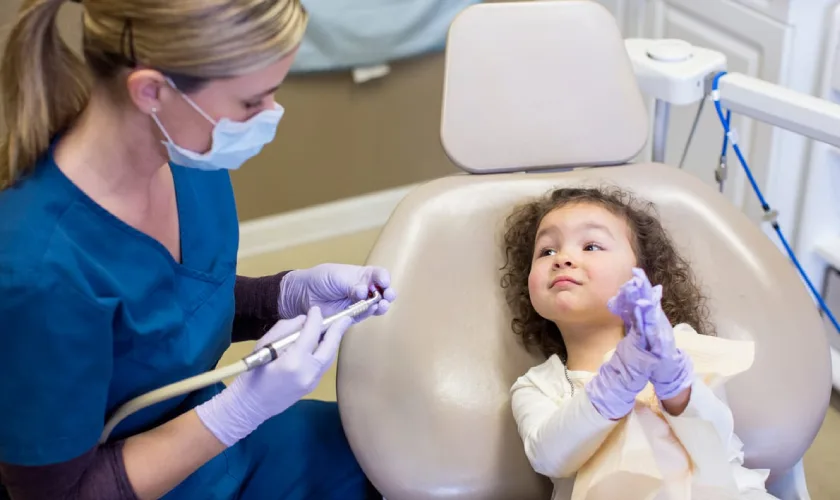
First visits are short and low pressure. Nobody expects a one year old to open wide on command.
The knee to knee exam. For babies and young toddlers, your child sits facing you on your lap and gently lies back so their head rests in the dentist’s lap. They can see you the entire time. It takes a couple of minutes.
A look at the teeth and gums. We check every tooth that has come in, look at the gum tissue, and check for early white spot lesions, which are the first visible stage of decay.
A quick cleaning. For a small child, this often means wiping or polishing the teeth with a soft brush rather than the full cleaning an older kid gets.
Fluoride varnish. A thin coating painted onto the teeth. It sets fast, tastes fine, and strengthens enamel against acid.
A talk with you. This is honestly the longest part. We go over bottle and sippy cup habits, nighttime feeding, pacifier and thumb sucking, brushing technique, fluoride toothpaste amounts, and what to do if a tooth gets knocked loose.
X-rays, sometimes. Not usually at a first visit for a very young child. We take them when we cannot see between teeth visually or when there is a specific reason to look deeper.
Older kids coming in for a first visit get the full version: a complete exam, cleaning, polishing, fluoride, and a conversation about what they can do better at home.
How to Prepare Your Child at Home
A few small things make a real difference.
Book a morning slot. Kids have more patience before nap time and after breakfast.
Keep your language plain. Say “the dentist counts your teeth and makes them shiny.” Skip words like hurt, shot, pain, and drill, even in a reassuring sentence. Kids hear the scary word and lose the rest.
Do not promise it will be easy. Promise you will be there. That is a promise you can keep.
Play dentist at home. Let them count your teeth with a toothbrush. Let a stuffed animal be the patient. Practice lying back and opening wide.
Watch your own tone. If you had rough dental experiences growing up, your child will read it in your voice before they read it in your words. Plenty of parents tell us this on the first visit, and we work with it.
What We Do for Nervous Kids
Some kids walk in fearless. Others need a slower path, and there is nothing wrong with that.
We use tell, show, do. We explain the instrument in kid language, let them touch it or feel it on a fingernail, then use it. We narrate everything so nothing lands as a surprise. We let a child hold the mirror and watch. If a child needs to sit in the chair and just look around on the first visit, that is a win, and we build from there.
For children with significant anxiety, extensive treatment needs, or special health care needs, we also offer sedation options at our Springdale office. Most first visits never need it, but it is there when it makes care possible.
After the Visit: Building the Routine
Walk out with a plan, not just a toothbrush.
- Brush twice a day, two minutes each time, with a rice grain smear of fluoride toothpaste under age three and a pea sized amount after that
- Brush for your child until they are around six, and supervise until eight or so, because the fine motor control is not there before that
- Start flossing once any two teeth touch
- Water between meals, not juice or milk, and nothing but water in the bottle at bedtime
- Come back every six months
Six month intervals are not arbitrary. Decay in baby teeth moves faster than it does in adult teeth because the enamel is thinner. Six months is short enough to catch problems while they are still small and fixable.
Ready to Get That First Visit on the Calendar?
At Hometown Family Dental in Springdale, we plan first visits around the child in front of us, not a stopwatch. Our team takes the time to earn your child’s trust, explain everything we see, and answer every question you brought with you. Whether your child is a year old or starting kindergarten, we would like to make this first one a good one.
Reach out to our Springdale office to schedule your child’s first dental visit.
Frequently Asked Questions
How old should my child be at their first dental visit?
By the first birthday, or within six months of the first tooth appearing. If your child is older than that and has not been seen yet, the right time is now rather than at some future milestone.
Will my child need X-rays at the first appointment?
Often no. We take X-rays when there is a reason, such as teeth that touch so tightly we cannot see between them, a suspected cavity, an injury, or a concern about developing teeth. When we do take them, we use digital sensors and protective shielding to keep exposure very low.
Can I stay in the room with my child?
Yes. For young children we encourage it, and the knee to knee exam is built around you being part of it.
What if my child cries the whole time?
It happens, and it does not mean the visit failed. Crying is how young children handle something unfamiliar. We stay calm, keep it short, and get the important parts done. Most kids who cry at visit one do noticeably better at visit two.
Do baby teeth really matter if they fall out anyway?
They do. Baby teeth guide the permanent teeth into position, and they are needed for chewing and speech development. An untreated cavity in a baby tooth can cause pain, infection, and damage to the permanent tooth forming underneath.
How much toothpaste should I use for a toddler?
A smear about the size of a grain of rice until age three, then a pea sized amount. Use fluoride toothpaste and teach your child to spit rather than rinse, so a little fluoride stays on the teeth.