
It is the question parents ask us most often, usually in a slightly apologetic voice: if the tooth is going to fall out anyway, does it really need a filling?
It is a fair question. Here is the honest answer, along with what actually happens if you wait, and what treatment looks like for a small child.
Baby Teeth Are Not Placeholders
A baby tooth does three jobs while it is in the mouth.
It holds space. Every baby tooth reserves the spot where a specific permanent tooth will come in. Lose one early and the neighboring teeth drift into the gap. The permanent tooth then comes in crowded, rotated, or blocked entirely, which can mean orthodontic treatment later that would not otherwise have been needed.
It lets your child eat and speak. Kids with painful teeth chew less, avoid foods, and sometimes swallow food barely chewed. Certain sounds depend on the front teeth being where they belong.
It protects what is underneath. The permanent tooth is forming directly below the root of the baby tooth. Infection in a baby tooth can reach that developing tooth and leave permanent damage to its enamel.
There is also a timing issue people underestimate. The second baby molars usually stay in the mouth until age ten to twelve. A cavity in one of those at age five is not a tooth that will fall out soon. It has years left to go.
Why Decay Moves Faster in Kids
Enamel on a baby tooth is roughly half the thickness of enamel on an adult tooth, and the pulp chamber inside sits closer to the surface. A cavity that would take a couple of years to become serious in an adult tooth can reach the nerve of a baby tooth in a matter of months.
That is the whole reason we ask to see kids every six months instead of once a year. It is not upselling. It is that the timeline is genuinely shorter.
What Untreated Decay Turns Into
The progression is predictable.
A white spot. Chalky, dull looking enamel. Not a cavity yet. This stage can still reverse with fluoride and better habits.
A small cavity. The surface has broken. Usually no pain. This is when a simple filling handles it.
A deep cavity. Now it reaches the inner layer of the tooth. Your child may complain about cold, sweets, or chewing on that side. The fix gets bigger.
The nerve is involved. Real pain, sometimes waking your child at night, sometimes coming and going. Now we are looking at pulp therapy and a crown rather than a filling.
Infection. A gum bump, facial swelling, fever. This can become urgent quickly and sometimes means the tooth has to come out.
Watch for the quieter signals too. Chewing on only one side. Refusing cold drinks. Suddenly turning down foods they used to like. Waking up cranky without explanation. Kids often do not report tooth pain as tooth pain.
How Cavities in Baby Teeth Get Fixed
Treatment matches how far the decay has gone.
Tooth colored fillings. For most small to moderate cavities. We remove the decay and rebuild the tooth with composite resin that matches the natural tooth color, so nothing looks obviously repaired.
Crowns for little teeth. When too much of the tooth is gone for a filling to hold, a crown covers and rebuilds the whole chewing surface. Stainless steel crowns are the traditional and very durable choice for back molars, and tooth colored options exist for teeth that show. A crown lets the tooth stay in place, holding its space, until it is naturally ready to come out.
Pulp therapy. When decay has reached the nerve, we clear the infected tissue from inside the tooth, place a medicated material, and cover the tooth with a crown. It is the baby tooth version of saving a tooth rather than losing it.
Extraction. Our last option, used when the tooth cannot be saved. If it comes out well before its natural time, we usually place a space maintainer so the neighboring teeth cannot drift into the gap.
What the Appointment Is Like for a Child
This is the part that worries parents more than the cavity itself.
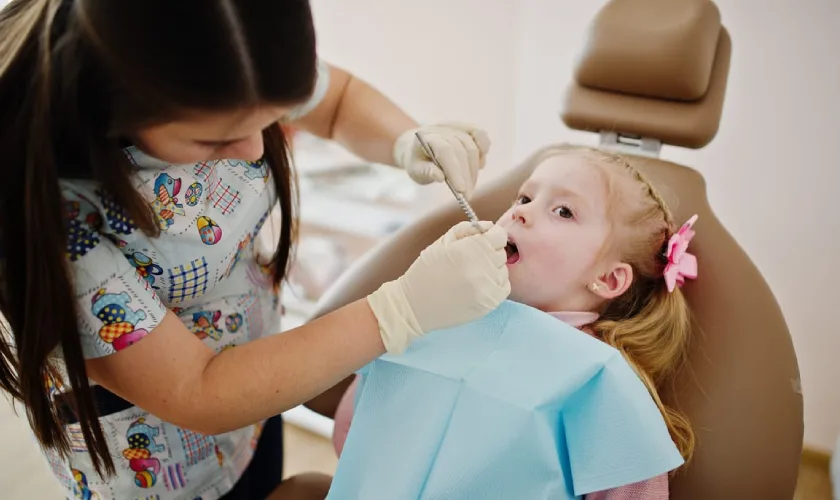
We explain each step in kid language before it happens. We do not surprise them. Numbing gel goes on before anything else, so the pinch most kids brace for is much smaller than they expect. We narrate, we take breaks, we let them hold a mirror if that helps, and we tell them what is happening rather than letting them fill in the blanks with imagination.
For children who need more than that, whether because of significant anxiety, very young age, extensive treatment needs, or special health care needs, we offer sedation options including IV sedation and general anesthesia at our Springdale office. Sometimes doing everything in one comfortable visit is far better for a child than five appointments they dread.
Do Not Wait for It to Hurt
Pain is a late signal, not an early one. By the time a child says a tooth hurts, the simple version of the fix has usually passed.
At Hometown Family Dental in Springdale, we treat cavities in a way that keeps kids calm and keeps their teeth doing their job until it is genuinely time to lose them. If you have spotted a dark spot, a chip, or a tooth your child keeps avoiding, let us take a look while the fix is still small.
Reach out to our Springdale office to schedule your child’s exam.
Frequently Asked Questions
Can a cavity in a baby tooth heal on its own?
Once the enamel surface has broken, no. Early demineralization, the chalky white spot stage, can sometimes be halted or reversed with fluoride and habit changes. An actual cavity does not heal and does not stop spreading on its own.
How do I know if my child has a cavity?
You may see a white, brown, or black spot, or a visible hole. But many cavities form between teeth where you cannot see them, and small cavities often cause no pain at all. A dental exam, sometimes with X-rays, is the only reliable way to know.
Will my child need a shot to get a filling?
Usually yes for anything beyond the most superficial cavity, because comfortable treatment depends on the tooth being numb. We apply topical numbing gel first, work slowly, and most kids report it was easier than they expected.
My child is only two and has several cavities. Is that my fault?
No. Early childhood decay comes from a mix of factors, including bottle and cup habits, the bacteria a child is exposed to, enamel quality they were born with, and diet. What matters now is treating what is there and adjusting the habits we can control going forward.
Why would a baby tooth need a crown instead of a filling?
When decay has destroyed enough of the tooth that a filling would not have solid structure to hold onto, a filling will fail and the tooth will need retreatment. A crown covers the whole tooth and holds up to years of chewing.
What happens if a baby tooth has to be pulled?
We evaluate whether the space needs protecting. If the permanent tooth is still years away, we typically place a space maintainer so neighboring teeth cannot shift into the gap and block it.